
I knew several ways to find notes on the guitar fretboard. I knew the open strings, could find the Cs, and could use octave shapes to work out other notes. Then I timed myself. On average, it took me about eight seconds to see a note prompt and play it. Eight seconds is quite a long time when you’re trying to do something musical.
I built FretGOAT, a paid fretboard practice tool. This is the problem I built it to help with, and my experience using it. This article is based on my own draft and practice experience, with AI assistance to edit and restructure the writing.
Knowing how to find a note
There are some excellent articles and videos about learning the fretboard. You can learn anchor notes, use octave shapes, or work on triads and pay attention to the notes that make them up.
Andrey Lushnikov’s article on memorising the fretboard, for example, groups notes into visual patterns to make their positions easier to remember.
These approaches give you somewhere to start. I was using several of them.
I knew the string names through an acronym, though it turned out I wasn’t completely fluent even there. I knew the Cs across the first twelve frets reasonably well, along with the Gs and As on the E strings. I’d spent some time on triads on the three highest strings.
But finding a note still involved a lot of calculation. Which nearby note did I know? Could I use an octave shape? Would it be quicker to start at the open string and count?
I could usually get the answer. I wanted to get there sooner.
The folded piece of paper
I’m old enough to have learned multiplication tables and language vocabulary using a folded piece of paper.
Questions on the left, answers on the right. Cover the answers, try one, then unfold the paper to check. Try very hard not to see the next answer and spoil the next question.
I wanted something like that for the fretboard, with the guitar in my hands.
Show me a note. Let me find and play it. Tell me whether I got it right. Give me another one.
The patterns and anchors would still be there when I needed them. But I wanted to practise getting from the prompt to the note, over and over, until there was less working out to do.
That became the core of FretGOAT.
What the practice looks like
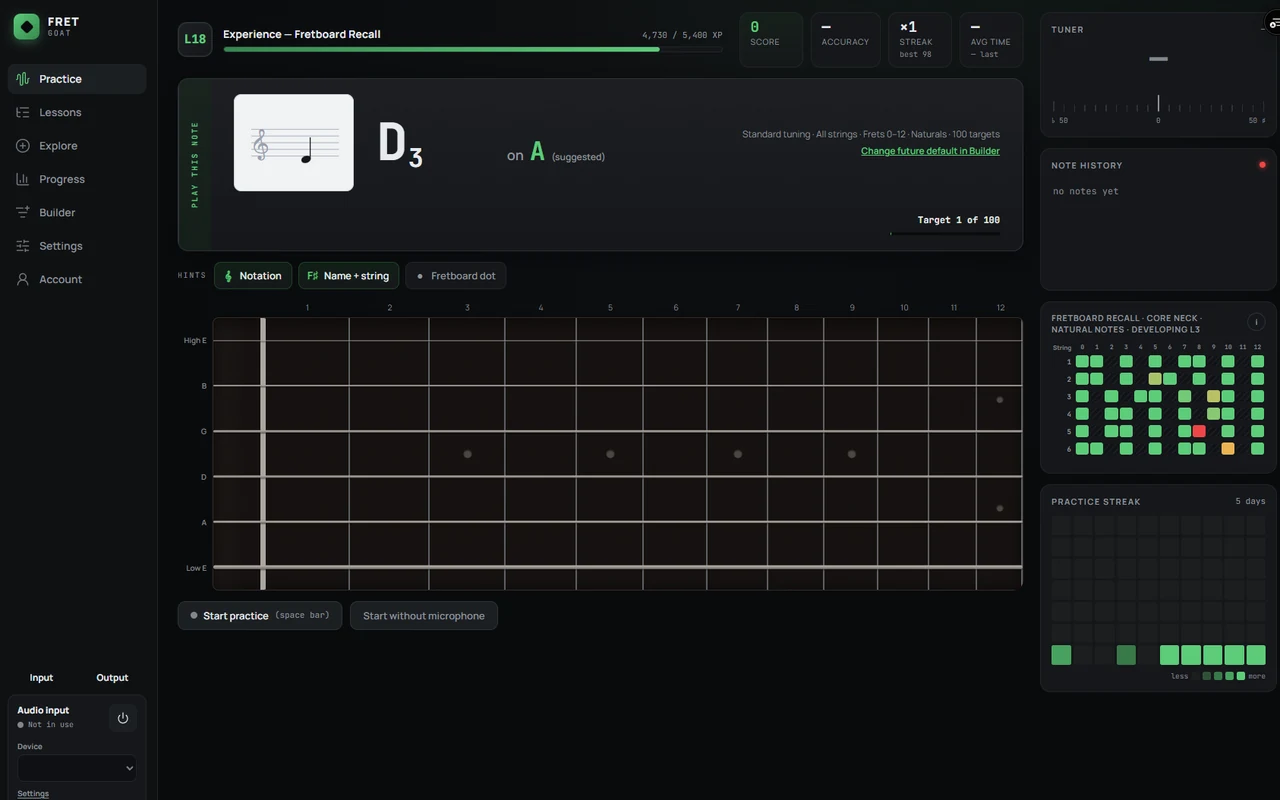
In a practice session, I choose the strings, fret range and note types I want to work on. My starting point was all six strings, open through the twelfth fret, using natural notes.
With the fretboard position hints switched off, I see a note name, octave and suggested string. I find the note and play it. FretGOAT listens and gives me immediate feedback. If I’m wrong, I adjust. Then I get another note.
Repeat.
You can try a simple version without the app. Choose one string and a small fret range. Write the natural notes in that range on separate cards, shuffle them, and draw one at a time. Find and play each note, checking against a fretboard chart when needed. Shuffle again so you aren’t just learning the order.
That gives you a feel for the exercise. I built FretGOAT to handle the prompts and checking so I could keep practising.
From eight seconds to under three
In my first sessions, I averaged about eight seconds from seeing the prompt to playing the note.
That explained why some of my other exercises felt so laboured. Working on a triad is slow going when finding the starting note takes that much thought.
A little before I reached 400 minutes of total practice, my average dipped below three seconds.
That’s my own experience, rather than a promise about how quickly someone else will improve. And the timer measures the whole response: reading the prompt, finding the note and physically playing it. It isn’t a pure measurement of memory.
Still, the difference was encouraging. I was spending less time counting.
Then the problem started to change
As I got quicker, I began noticing the separate parts of the task.
Sometimes I knew that A on the D string was at the seventh fret, but still had to get my left hand there and my right hand onto the correct string. I’d glance down to check where both hands were.
There are still notes I hesitate over. But movement has become a more noticeable part of the delay.
Lately, I’ve been doing single-string exercises to practise moving between frets without looking. Between three and seven feels manageable. Finding two has a different feel.
But nine? Or eleven versus twelve? Still working on it.
Next, I want to combine that with moving between strings. There’s plenty left to practise, but I can be more specific about what needs work.
What knowing the notes is actually for
Mostly, I don’t work through patterns to find notes any more. I’m aware of the octave shapes, but I’m no longer starting from a C and moving two strings and two frets to find another one. I usually just know where to go.
That has made practising triads much more fun. I can find the notes quickly enough that the exercises are starting to sound musical.
I don’t have to work through every triad in a key in sequence. I can pick a song and play its triads, then move on to another song. Finding the notes takes less of my attention, so I have more room to hear what I’m playing.
That was the reason I wanted to learn the fretboard in the first place. I wanted to be able to move around it comfortably enough to enjoy making music.
There are still gaps, and I’m still practising. FretGOAT makes that practice easy to get into: get a prompt, play a note, get feedback, try again. With just enough encouragement to make me want another session.
You can start free with natural-note practice from the open strings through fret 5—what FretGOAT calls Open Position. The paid Founding Pass opens up broader fretboard practice, including the range described here.